Kindness is Mentored: Meanness is Modeled

I have learned to truly appreciate kindness as I get older. I have watched how important being kind to one another really is as the world has gotten more political and divisive.

As a mother, I always tried to teach my children to be kind. I encouraged gentleness with all living things. I guided them to be quiet and respectful with old people. I wanted my children to make the world a better place.

Meanwhile, I modeled something quite different. I am angry. My plans for myself and my daughter have been high-jacked by epilepsy. My career was side-tracked. My retirement was greatly reduced. I became a prop in Rose’s world. This was my doing. I thought that if I gave up more…she would have more. But that is not how the world works.

My anger seeped out while Rose was watching, since we were always together. It was usually not directed and her, but I feel somehow she knew that my rage was related to her. We were tethered together for months at a time while the seizures were at their worst.

I modeled meanness. I yelled at other drivers. I growled under my breath in stores. I threw things. I used profanity.

Rose was watching and listening. I had mentored my children correctly, but my modeling was horrific. Do as I say, not as I do?

Rose is a good person. She is kind. When she spews anger, I see myself and I am ashamed.

Do not do as I have done, Another Mother.

Mama FLOW

Kind Kids

Reposted Chapter 24: Kind Kids

Of course epilepsy came on vacation with us. Rose had three seizures during our week at the beach. Two occurred while she was swimming in the pool. She always wore a life jacket in the water and someone stayed an arm’s-length away. I knew it was risky to let her swim, but she loved it so much. We live on a lake so our family and friends swam a lot. We could not forbid Rose from participating in something we all enjoyed together. If she seized in the water, we just held her until the seizure ended and carried her out to a lawn chair to sleep afterward. We suspected extreme temperature changes triggered seizures, and so we tried to avoid the water in the mornings when it was cooler. We also covered Rose with a towel when she got out so she would not get chilled.
Rose also loved the ocean,but swimming with her among the waves made me a complete wreck. I was afraid we would both go under if she seized in the ocean. She was content to go in for only a few minutes and then play in the tidal pools with her shovel searching for little fish and shells, and building sand sculptures.
One day Rose and I had just walked down onto the beach and picked our spot on the edge of a tidal pool. I set down our bags and towels just as Rose fell face first into the sand. I placed her on her side to seize, as I tried to wipe off some of the sand that stuck to her face. A nice lady nearby offered me a bottle of water to wash her off. The seizure soon ended, but Rose was covered in wet, sticky sand. I swaddled her in a towel and sat close beside her to wait out the thirty minutes or so it would take before she woke up. My family could see us from the porch of the condominium, so I knew help would arrive when someone spotted Rose lying still under a towel.
While I was sitting quietly beside Rose, two boys about her age walked by. They were carrying a surfboard, table-fashion, covered with an assortment of shells and seaweed. They both glanced at Rose as they passed, but soon put down their board and walked back to me. They asked what was wrong with Rose. I explained that she had had a seizure but would be fine when she woke up. I asked about the treasures they were carrying on their board. I shared that Rose would have loved to see their haul from the sea if she were awake. They walked back to their board and one returned carrying a giant pin shell. “Give her that when she wakes up” he said. We still have this treasure.

Seizure Mama speaks to parents:

There will be many children who do not understand seizures Some children will be afraid of your child after seeing him/her seize. There will be a stigma. It will be harmful and painful.
There will also be children with great kindness,who will be protective of your fragile child. They will be loyal friends. Relish the memories of the kind kids. They are the angels of this broken world.

MAMA has a lot to say about this one.

Medication and Hydration

(THEN and Now for Chapter 23: Toxic with a Timer)

Your body is set up as two fluid compartments. Molecules and ions move across the membranes between these two compartments by diffusion or active transport. Diffusion moves from a high concentration to a low concentration. This requires a solvent for the solutes, in this case medications.

That solvent is water. That magical, universal solvent that makes all life possible. To move medications takes water. Cells need to have water inside them and around them to work properly. Drinks like soft drinks (and alcohol) actually pull water out of the system because they are hypertonic. So not any fluid will do.

If you or your patient does not like to drink water, then splash in some juice for flavor and color(not red). You may require the patient to drink a glass of water before a glass of a favorite drink.

Think of water as a transport system like little rivers in your body taking substances back and forth to and from your blood vessels. These tiny waterways between cells are essential for movement. Solutions need dilution to get to a proper concentration level to move ions between the two fluid compartments.

Not enough water leaves good substances on the ships and bad substances on the loading docks. Water keeps it all moving in or out.

Medications require proper hydration to get where they need to go. Keep everything moving with water. You will feel better.

P.S. To avoid holiday ‘cotton mouth’, drink copious amounts of water after a binge. Keep a tall glass by your bed for that moment when you awake with a dry mouth and a headache. You may want to set two pills of some sort out with it.

Keep it moving!

FLOW

Nobody Argues with Paper

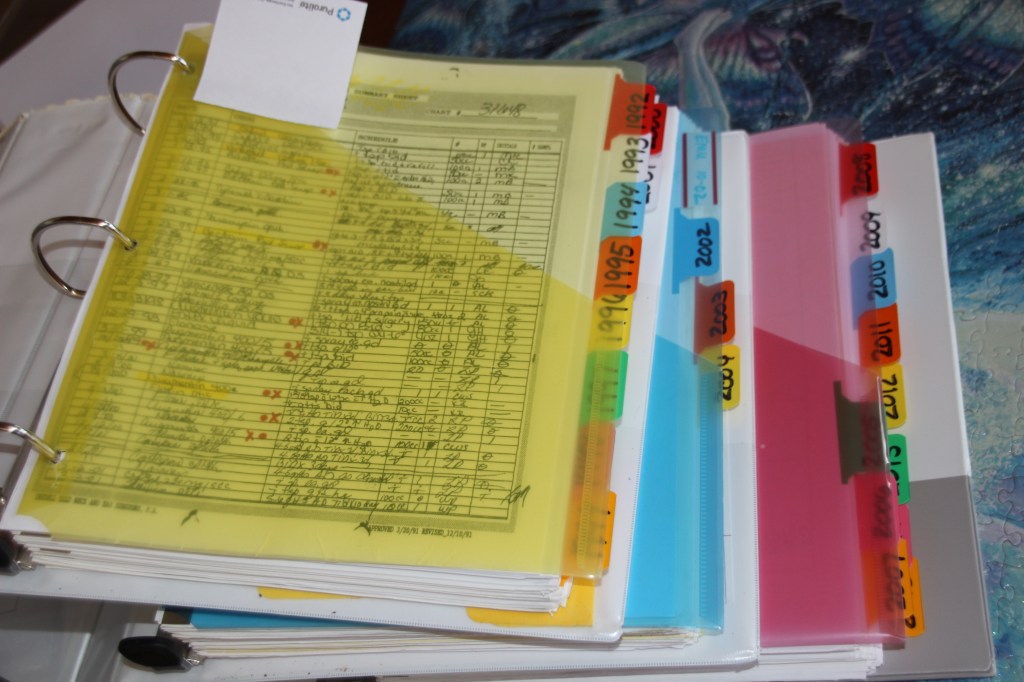
Write everything down. Take notes on envelopes and receipts. Keep all this in one place. Just date it and throw it in the box or drawer. That way these facts are not swirling around in your mind and cluttering your thinking. When you need some bit of information from your stash, get a notebook, paper and tape. Use them to organize the scraps. We use dividers to separate the years.

I cannot tell you how many times I started worrying about something in the middle of the night and had to go to “the drawer” to retrieve a forgotten piece of data before I could go back to sleep. All those pieces of paper saved Rose and resulted in our book.

We made a chart for each year and wrote down any event. We can glance at that one page and get a sense of how our lives were at that time. It is nice to put this away for safe-keeping instead of remembering it over and over.

A year in the life of our Rose.

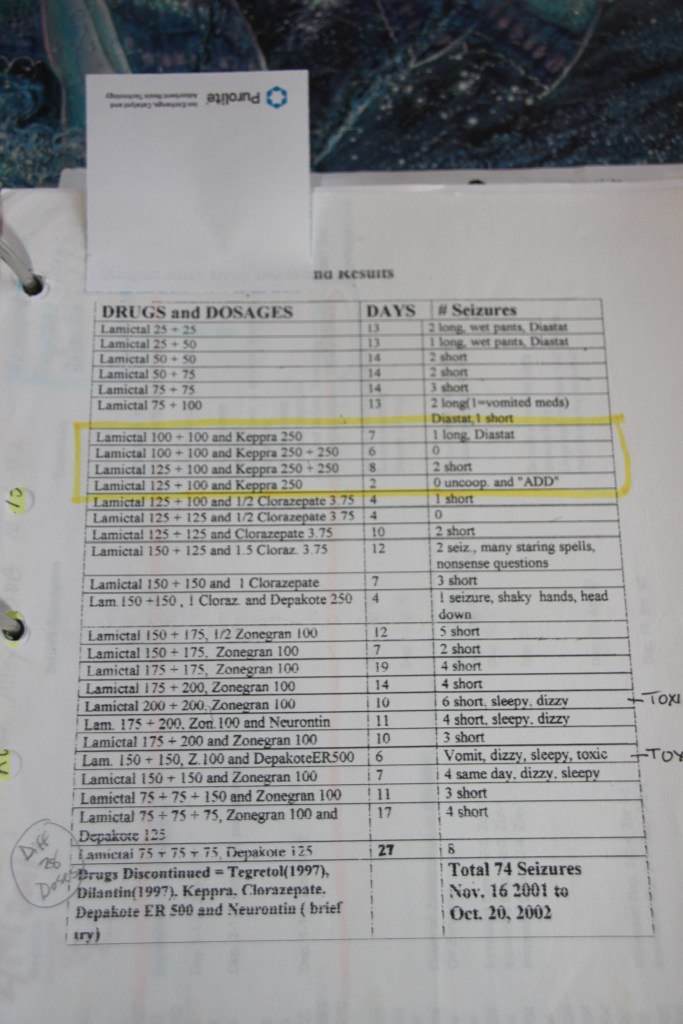
When medications were being changed quickly, we made a different chart with drugs, days, seizures and side effects right there in black and white. We took these to appointments. Nobody argues with paper.

The chart from HELL. Mercy!!!!

I learned this trick as a teacher. I posted the rules on the wall of my classroom. When a rule was broken the student might try to argue. It was then I would simply walk to the poster and point to the broken rule and pause. The rules had been up since day one. No reasonable person would argue.

So the file drawer eventually became two full file cabinets. They are full of marked up seizure books we have read, articles we researched. All her records of every prescription by years are in one drawer. Twenty years went by in the blink of an eye, but it’s all there if I need it. Nobody argues with paper.

The notebooks.

Once when we were leaving the EMU, Rose was being sent home on dosages that were too low. The doctor in charge was abrupt and intimidating. I meekly showed him my records of Rose seizing on that low dosage. He looked and paused, but said nothing. Her dosages were not changed. We went home. She had a long, strong seizure on the couch while the neighbors were visiting. I called back to the EMU, the dosages were raised immediately. I guess he did not want to be wrong until he was proved wrong. Nobody argues with paper.

Mama FLOW

Toxic with a Timer

(Reposted Chapter 23: Toxic with a Timer)

Rose’s latest drug combination became a recipe for disaster. Now she was constantly dizzy and nauseated. She was limp and barely moving or responding. She was silent. She was being poisoned.
We put her on the couch so we could all keep an eye on her. At this time, she was on three drugs,one of which was an extended release form. One drug must have amplified the affects of the other two. Her nausea and vomiting soon turned to dry heaves and bile. Her seizures were clustering. We knew she was in danger.
We called the on-call neurologist at about 11PM. The doctor’s foreign accent made our conversation difficult. My husband and I were both on the line listening. We thought the doctor said to use the emergency drug if Rose had another seizure and then take her to the Emergency Room if she had another seizure after that. Was that really what the doctor said? Two more seizures and then the ER?
The next morning Rose was very pale, weak and, listless. She barely moved. We tried desperately to get her to eat and drink each time she woke up. She was fading before our eyes. I called the doctor’s office as soon as it opened to report Rose’s condition. I cried as I explained that she seemed poisoned by these three anti-convulsant drugs.
The wise nurse calmly told us to get a timer. She said to set it for twenty minutes. Every time it went off, we were to wake Rose up and make her sit up, and sip some water. We set and re-set the timer all day long. For hours we watched her and waited for the timer’s bell to ring, over and over.
Hours later she began to improve. The poison was being diluted. Rose was re-hydrating. The color came back in her face. She was safe. No trip to the Emergency Room required.

Seizure Mama speaks to parents:

We kept gel in the refrigerator to put on Rose’s arm for nausea. There were several times when her vomiting led to seizures because she had thrown up her medication. We began sifting through her vomit if it occurred soon after a dose of medications. I know this seems gross, but you need to know whether a dose needs to be replaced or not. Doubling a dose may be worse than missing a dose. You need to be sure which to do.
This particular situation was the exact opposite of seizing due to lack of medications. Rose was sick and seizing before ever throwing up. Her dosages were too high. The combination was too much. She was listless and unresponsive. I still distinctly remember this because I was so afraid.
Know your child’s dosages and drugs. If you go to the Emergency Room, drawing blood and checking drug levels may be an important piece of information for the doctors involved in the treatment.
We wrote down all dosages on a calendar and used a pill organizer. There was no guessing about the medications that were taken. We also recorded how the dosages affected her. This information was used to convince the neurologist that she needed a different drug or combo. Do not count on your memory. Write it down.

Hovering Over Rose

(THEN and NOW for Chapter 22:Safety During the Seizure Cycle)

There is no other way to describe our parenting style during those terrible months. It is hard to act relaxed when you are constantly on high alert, but we tried. We endured puzzled looks from strangers. Sometimes we got unsolicited advice. We learned to tolerate all this. It was part of the over-protective parent package. We were protecting Rose from injury, not public opinion.

I know this is a hard pill to swallow. Most folks mean well and are truly trying to help. Some advice is so ridiculous that taking it would be harmful. Our worst treatment suggestion came from a loaned book. It stated that we should hook up the patient to a car battery and shock him/her to kill the Ascaris lumbricoides (worm)larva that were clustering at the base of the brain and cutting off the oxygen supply.

Wow! Thanks!

You do what you have to do. This is your fragile child. You will have to live with the results of the drugs and injuries. You need to let the opinion of others fade into the periphery and stay focused on your child’s needs.

If the doctor suggests a helmet, let your child pick it out and decorate it. If you cannot safely leave home without your child strapped in a wheel chair, get one and decorate it for a parade. Embrace whatever it is you need to do to carry on, and do it shamelessly. (I once saw an advertisement for colostomy bags with matching bikinis. That’s how it’s done! )

Sometimes I wonder if I am helping anyone. I do not like giving advice, but I am telling you what I wish someone had told me twenty years ago.

FLOW

Safety Tips from a Seasoned Seizure Mama

Reposted Chapter 22: Safety During the Seizure Cycle

The drug roulette regimen made everything worse. Rose was not herself before a seizure nor after a seizure. She was lethargic, floppy, and dopey. She moved from her bed, to a chair, to another chair, and back to her bed. The seizures came with us wherever we went. She seized in restaurants, at birthday parties, at Brownies, in the yard, watching television, in a big box store while shopping for a helmet, at a family reunion and even in swimming pools.
We took a plastic Adirondak chair with us on outings. The chair reclined slightly, so she could seize in it without falling out. For us every party was BYOC(bring your own chair), and of course the seizure bag went with us everywhere. We evaluated the risks of each outing. Should we go eat at this restaurant? No, it would be too hard to carry her out through the gift shop. She we go to a ballgame? No, seizures in bleachers are too dangerous. Should we go? No. Eventually, we stayed home waiting for the next seizure. I really wanted to buy a little wheelchair, so we could go places, but was advised against it by other family members. Rose would look handicapped and feel handicapped. Yes, but she would be safe.
We walked everywhere linked arm in arm with her. A fall could come at any second. We went up and down our stairs as a unit so she would not fall. We called this method ‘stair pairs.’ To go down Rose would put her left hand on the person in front’s shoulder and her right hand on the handrail. The front person would put their left hand on hers and also hold the rail with their right hand. Going up would be reversed with her escort behind her. Rose would announce when she wanted to go up or down and someone would stop what they were doing and escort her. We made it a point to not say no to her requests to use the stairs. There was so much she could not do at this point; at least she could be free to move about in her own house.
When no one was in a room with Rose, her father, brother or I would whistle two notes and she knew to echo the two notes back. We whistled instead of calling her name so she knew we were just checking on her instead of needing her to come to us. We whistled to her about every three minutes. It got to be so much of a habit that I would catch myself whistling notes when Rose was not with me. She slept with me during these terrible months. Sometimes she would whistle in her sleep. We referred to this as “echo whistling.” If she did not repeat our two notes we would call her name. If she did not answer, we would rush to find her. Sometimes she was just too busy to answer, but a few times we would find her unconscious, leaving me feeling feel guilty about leaving her alone. Negligent for three minutes. Shame on Seizure Mama!
Take a chair, echo whistling, stair pairs. This is how we kept her safe as the seizures took over our lives.

Seizure Mama speaks to parents:

You need to devise methods like ‘echo whistling’ and ‘stair pairs’ as part of your everyday routine to keep your child safe. We used two notes for ‘echo whistling’ because Rose had complex partial epilepsy and could do repetitive automations, even at the onset of a seizure. She could probably whistle during these periods, but could not echo the two notes from someone else.

Call me a helicopter! Preventing injury and status was my full-time job.

A Forced Hand

(THEN and NOW for Chapter 21: The Painful Appointment/Past Time for a Change)

Being proactive takes confidence. I had none at this point. I did not have a clue what to do.

But I did know what not to do, which is what we had been doing. We were poisoning Rose to try to stop her seizures. She was disappearing and they were still with us.

I remember the slaw and the spork. I remember Rose’s pale face and shaky hands. The day was painful, the appointment was excruciating.

I still had a tiny spark of fire deep inside my watered down and drowning mama-self. That spark flamed up as I watched Rose struggle to sit up and put food in her mouth. Something had to change. I had to do something.

It does not matter whether the fire lit was fear or love. What mattered was that it forced my scared self back up to that office to shakily whisper what I needed for my baby. (Rose was nine.)

That spark grew as I contemplated what to say in that waiting room. By the time we got to meet with the doctor again, my forced hand was on fire. Yes, I was intimidated. But change was necessary. New drugs? New doctor? No matter. It was Past Time for a Change!

Past Time for a Change

Reposted Chapter 21: The Painful Appointment

We had felt good about the first neurologist in the beginning. The doctor was observant and thoughtful. We had previously left each of our appointments with several written plans of action in case the first option did not bring the results we hoped for. If plan ‘A’ did not work, we also had plans ‘B’ and ‘C’ if needed. Now we felt like Rose was part of a chaotic experiment without planned strategies or goals.
Rose had a long and strong seizure the day before this appointment. She slept on the way to the doctor’s office and wouldn’t hold her head up during the visit. The doctor seemed not to notice Rose’s lethargic condition. Instead I was scolded for the numerous calls I had made to the nurses. The doctor mentioned wanting another EEG(electroencephalogram) and mentioned the possibility of VNS(vagus nerve stimulator) placement.
We were taken aback by these suggestions. We thought we had come for a much needed plan for our next trials with different medications. Instead it seemed that we were at the end of the medication regimen and headed for surgery. Our instructions were to stay on drugs 3S, 4L and 5Z. Stay on these three drugs? What we were doing was not working. Why were we not doing something different?
Here was our nine year old daughter slumped down in a chair, pale and unresponsive and we were supposed to continue on with these same drugs and dosages. We left the appointment and went downstairs in the building to eat lunch at one of Rose’s favorite restaurants. Rose’s hand was so shaky that she couldn’t use a fork. I had to feed her the slaw. I was feeding my nine-year-old because she could not feed herself, but there would be no change in her treatment? This was unacceptable and infuriating.
We all went back upstairs to the doctor’s reception area. I was so shaken that I could barely speak as I explained to the receptionist why we were back. We had to wait until all the other families finished their appointments before the lunch break. It was interesting watching the other struggling families while we waited. The parents were anxious while the children were bored and restless. One father was irate and loud about a mistake that was made by the receptionist.
Finally we got to speak with the doctor again, and before we left we had a new plan. I had the doctor write it down. I still have the paper. Rose was to go down on 4L, off of drug 3S go up on drug 5Z and add a new drug 6K. Was this a plan or a punishment? This was like playing a game of roulette using strong drugs on a young child. Was this new plan better than no change? It gets worse from here.

Seizure Mama speaks to parents:

You must be politely proactive. Although different dosages and a new drug made things worse in this circumstance, sticking with the same regimen would have prolonged the process of finding the right combination. Months later we concluded that 4L was the drug from hell. We never found the therapeutic dose. The effective window was so small that we shot past it and Rose eventually went toxic on this drug combination.
Keep good records and write down everything. Things got so bad that I couldn’t think straight. I was a wreck during these months. We felt damned. Maybe you know how that feels. God help us all.

Drugs can be Poison

Then and Now for Chapter 20: Drug Changes Change Rose

This period of time will always come back vividly due to the fear I felt every minute of every day. “Things fell apart. Months were a blur.” this chapter says. We were panicked by Rose’s decline. All we had were strong seizures and horrible side effects. I did not want to take my eyes off of her, but I was cracking up inside. Something had to give.

I have had to ask myself some hard questions about this stretch of Rose’s epilepsy. Why did we go along for so long? I am trying to be honest and careful here because I know some of you may be going through similar experiences.

When do you bail water or bail out? I think we bailed water too long here. Why? Ignorance and insecurity. We did not know what to do to help Rose, so we did what the doctor told us. A few hand slaps from a doctor makes one hesitant to argue. I was trying to study drugs and other treatments that I could barely understand. I had to trust somebody else to know what to do. But the doctor did not see Rose lying on the couch all day, listless and pail. She did have to support her as she walked. She did not hear her voice flatten and her eyes flutter.

If you are this scared of the drugs or the doctor, bail out.

GET A SECOND OPINION.

Tell them Flower sent you.

I cringe when I remember this period. If we had continued on this path, I am not sure that the Rose we have today would even exist now.

Love,

Flower